
We Moved 10x Faster With AI. We Also Ran Out of Places to Hide the Waterfall.
I’ve recently had that exact moment I realized something had quietly shifted.
We were in a sprint retrospective. One of our engineers had spent the previous two weeks using an AI coding assistant — the kind that doesn't just autocomplete but suggests entire features, flags edge cases before you write the test, and sometimes just... solves the ticket before you finish reading it. Velocity had nearly doubled. We were shipping more in two weeks than we used to ship in five.
Everyone in the room was smiling. The Scrum Master was practically glowing.
And then our designer, almost to herself, said something I haven't stopped thinking about since: "If we're already deciding everything up front anyway, and now we can just build it faster... what exactly are the sprints for?"
The room went quiet. Not an uncomfortable quiet. More like the kind of quiet that happens when someone says the thing everyone was already thinking.
She was right. And the terrifying part wasn't the question. It was that nobody had a clean answer.
The Confession Nobody Is Making
Here's the thing about Agile in most organizations: it was always, at least partially, a performance.
Not because people were dishonest. But because the honest version — the version where you genuinely don't know what you're building until users tell you, where a roadmap is a hypothesis and not a contract, where a feature can be killed mid-sprint without a change request form — that version is existentially threatening to most businesses. To their sales pipelines. To their investor updates. To their quarterly board slides.
So what happened, gradually, across thousands of teams worldwide, is what I wrote about before: we started doing Waterfall in a costume. We kept the sprints and the standups and the retrospectives. We lost the thinking underneath them.
We called it Agile. We meant "we deliver in two-week chunks."
For a long time, that worked fine. The costume was convincing enough. The ceremony provided enough psychological cover. And importantly, there was no obvious test that exposed the gap between the philosophy and the practice.
AI just became that test.
What AI Actually Revealed
When or if AI tools enter fully in the development workflow, they will do something nobody anticipates: they should compress the cost of building dramatically. Features that used to take two sprints take one. Specs that used to require three meetings get drafted in twenty minutes. Boilerplate that used to eat two days of engineering time disappears into a prompt.
And when the cost of building collapses, something else collapses with it: the justification for all the process around building.
Think about what sprint planning actually exists to do in most teams. It's not really to discover uncertainty. It's to allocate work. To portion out the backlog. To figure out who does what and when. To produce a forecast that leadership can nod at.
When AI can do the allocating, the drafting, the scoping in a fraction of the time — suddenly two weeks of careful sprint planning to produce something an AI could scaffold in an afternoon starts to look like a very expensive ritual.
The ceremony didn't become obsolete because AI is smarter. It became obsolete because AI made the real purpose of the ceremony undeniable.
We aren't iterating. We are scheduling.
The Red Flags AI Makes Impossible to Ignore
I've written before about the signs that a team is doing iterative waterfall dressed as Agile. The quarter-locked roadmap. The pre-approved demo. The discovery phase that happens once and then closes forever.
For years, these red flags were easy to rationalize away. "We're moving fast." "We're being pragmatic." "Pure Agile doesn't work at our scale."
AI has a way of making those rationalizations evaporate.
If your roadmap was fixed six months ago, AI doesn't make you more Agile — it makes you faster at building the wrong thing. Speed without direction isn't velocity. It's just a more expensive mistake, arriving sooner.
If your sprints are delivery units rather than learning units, AI just makes the delivery faster. Great. Now you can ship a feature nobody asked for in five days instead of ten. The metrics look wonderful. The outcomes are identical.
If your retrospectives are polite theater, AI in the room doesn't make them honest. It just means you now have a very efficient transcript of the theater.
The process rot doesn't disappear when you add AI to the stack. It accelerates. And unlike before, you can't hide behind "well, building takes time" as the reason you're not learning faster. Building no longer takes that much time. The question of why you're not learning becomes a lot harder to avoid.
The Teams That Will Survive This
There's a version of this story that's actually hopeful. And I think it's the more honest version.
The teams I've seen who use AI tools and get genuinely better — not just faster — are the ones who were already doing something close to real Agile. They were already treating sprints as experiments. They already had a user in the room, not as a product persona on a slide, but as an actual person with an actual problem they were genuinely trying to solve. They already celebrated killing a feature more than shipping one.
For those teams, AI is extraordinary. It doesn't replace their process. It amplifies it. They can run more experiments in the same amount of time. They can test more hypotheses. They can learn faster.
But the teams running iterative waterfall in an Agile costume? AI just gives them a very fast car with no steering wheel and no map. It's impressive until it isn't.
What Comes After Agile
I don't think Agile dies quietly. It's too embedded, too certificated, too LinkedIn-headline-friendly for that.
What I think happens is subtler: Agile becomes the thing we said we were doing before AI, the way we say we "manually" did things before automation. A reference point. A before photo.
The teams that survive the next five years won't be the ones who did Agile correctly. They'll be the ones who genuinely internalized what Agile was trying to say: that you don't know what to build until you talk to users, that a plan is a hypothesis, that changing your mind is not failure — it's the whole point.
AI is neutral on all of that or it should be. It can make a learning organization dramatically faster at learning. It can make a bureaucratic organization dramatically faster at bureaucracy.
The irony is that the Agile Manifesto — the original one, from 2001 — was never really about sprints or story points or velocity. It was about one thing: responding to change over following a plan.
Most organizations never did that. They followed the plan and called it Agile.
Now the plan is being written by AI. And faster than ever.
The question from my last post still stands, and now it has more urgency than it ever did: when did a user interaction last change what your team built?
If you're struggling to answer that, the problem was never your sprint length.
It was never your tooling.
It was never your framework.
It was that you built a costume and forgot what it was covering.
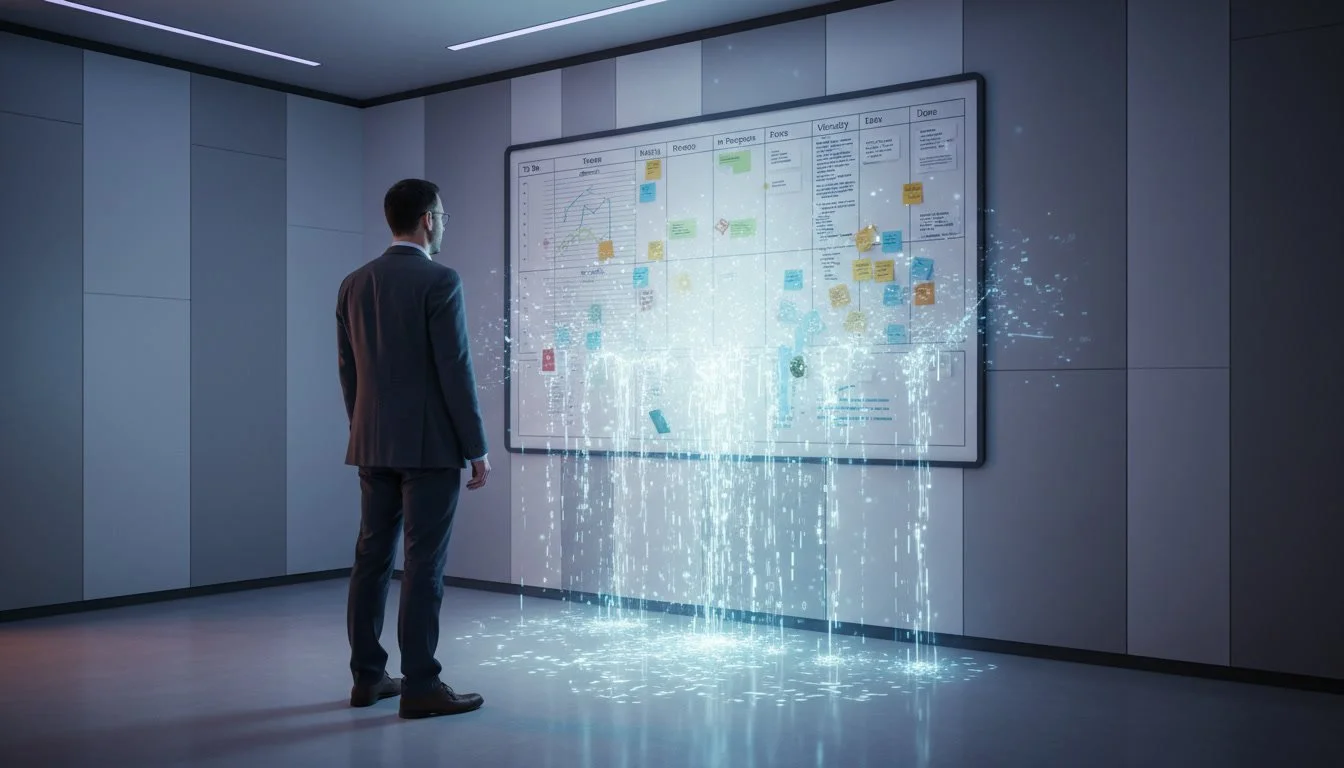
AI will just make the costume transparent.
