
AI criticizes my son’s first art piece
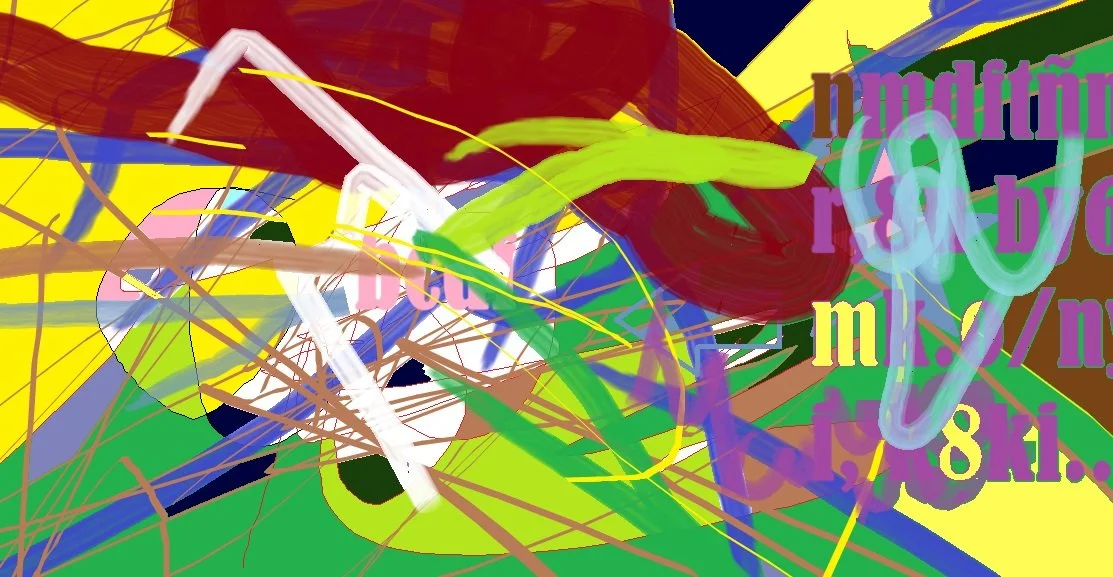
It is well established that AI hallucinates from time to time, which is great; this is exactly what I need. I have an image from a year ago, where I allowed my son to use Microsoft Paint to play around on the PC, so he was pressing the buttons, playing with the mouse, going into Gmail, and I returned him to Microsoft Paint. And we went into this circle several times. Until he finally gave up, or as I took it, finished his first master artwork.
I hold this memory very close to my heart, but today I have an idea: I’ll ask AI models to act as top-notch art critics, or curators, and analyse the art that my son made. As a proud father, I’m happy to show this to you, but to be fair, it is just a mish-mash of nothing to be really looked at.
The prompt
So I had to research a bit about how people in real life look at an art piece. Well, I didn’t get too much about this line of business, I did learn enough to assemble a decent prompt. So here is what I’m going to use:
Act as a top-tier art critic, curator, and visual theorist with experience in contemporary and classical art. Analyze the uploaded photograph with the rigor expected in a professional art review or gallery assessment. Structure your critique as follows:
Immediate Visual Impact – first impression, emotional resonance, and attention dynamics.
Composition & Form – framing, balance, geometry, perspective, use of space, and visual hierarchy.
Light, Color, and Texture – lighting quality, color relationships, tonal range, materiality.
Concept & Intent – inferred theme, narrative, symbolism, and conceptual coherence.
Art-Historical & Contemporary Context – references, influences, and positioning within relevant movements or practices.
Technical Execution – craftsmanship, control of medium, strengths ,and limitations.
Critical Assessment – what works exceptionally well, what weakens the piece, and why.
Professional Recommendations – concrete suggestions for refinement or alternative approaches, assuming gallery-level ambitions.
Maintain an objective, articulate, and precise tone. Avoid generic praise. Prioritize depth, clarity, and professional judgment over politeness.
The results
Let AI do what it’s best at, hallucinate. I’ve asked Gemini, ChatGPT, Claude, Perplexity, Grok, as usual, but I also decided to ask DeepSeek and include an AI tool that provides art critique, such as foundmyself.com. Here are 5 things they’ve found in common:
High-Frequency Visual Impact (The "First Interaction")
Across almost every AI, the artwork is described as having an immediate, often aggressive sensory pull.
More interesting comment to me is that the image is causing sensory overload and a "cacophony" of energy that borders on a visual assault,
The more the image is described as delivering a "stark, minimalist shock" that creates a disquieting gravitational pull,
AI consistently mentions that these pieces produce a sense of urgency or instability rather than a moment of quiet contemplation.
A Struggle with "Visual Hierarchy" (The Navigation Problem)
The AI highlight a recurring issue: the eye doesn't always know where to land. In product terms, the UI is cluttered.
Many of the AI critiques point out a lack of a clear focal anchor, which makes the viewing experience "exhausting" or "disorienting.",
The compositions are often described as anti-hierarchical or "de-centered," where every element—from neon slashes to text fragments—demands the same amount of attention.,,
Even in the more structured photographic work, the "ruthless" binary of the subject against the ground forces a material confrontation that denies traditional depth.
Intense Engagement with "Materiality and Noise"
Whether the medium is digital pixels or physical decay, the sources focus heavily on surface-level intensity.
The AI models highlight a "high-frequency visual noise" and "chromatic fatigue" caused by maximum saturation and clashing RGB colors.,,
The photographic analysis shifts this focus to texture as the primary subject, describing a "visceral form" with "eroded materiality."
There is a shared observation that the work often feels like "information overload" or "digital entropy," reflecting a world of corrupted data and fragmented narratives.,,,
Direct Ties to "Art-Historical Movements"
Each AI attempts to "position the product" within the market by comparing it to established historical "brands."
Abstract Expressionism (specifically Jackson Pollock) is cited multiple times for its gestural marks and "all-over" style.,,,
Glitch Art and Post-Internet Art are frequently mentioned as the contemporary framework for the digital chaos.,,
The more clinical work is linked to New Objectivity and the legacy of Modernist still life, showing a shared critical habit of looking backward to explain the present.
The Need for "Ruthless Editing" (Post-Launch Refinement)
Almost every AI model recommended that the artist (my son) needs to cut back on the "features" to improve the "product quality."
Some AI models suggest "editing ruthlessly" by removing up to 70% of the elements to allow the remaining components to breathe.,
There is a consistent call to establish a clear hierarchy and limit the color palette to move the work from an "amateur/hobbyist level" to "gallery-ready.",
The final verdict across the board is that while the energy is undeniable, the work currently lacks the "authorial decision-making" and technical mastery required for a professional "release.
The final thoughts
Does it make sense to ask AI to count to 1 million? No. Does this experiment make any sense? Not at all.
I did have fun. Something that my son was just playing around with the MS Paint and PC mouse, came up to be what you see above.. I hold it dear, because it is a memory that I have with my boy in my lap clicking and playing, and typing, rather then the value of the art itself. But Ai doesn’t know this.
It just felt like one of those experiments, where a wine expert, brought some cheap wine. relabelled it, and won the competition, just by having a well-known reputation. In that way, AI also acted. So the lesson learned is be careful what you wish for.
Or in my case, be careful what you prompt for.
