
From Clay Tablets to Jira: How Communication Technology Shapes Product Management
Recently, I was listening to a podcast about ancient cultures and Sumer, and there was a discussion about clay tablets. What struck me was how descriptive and precise they were. These weren't casual notes—they were carefully crafted records that survived millennia in remarkably good shape.
It got me thinking about the journey from writing on clay tablets to writing epics, stories, and tickets in Jira. How has the written word evolved with technology, and more importantly, what has that evolution done to how we work as product managers?
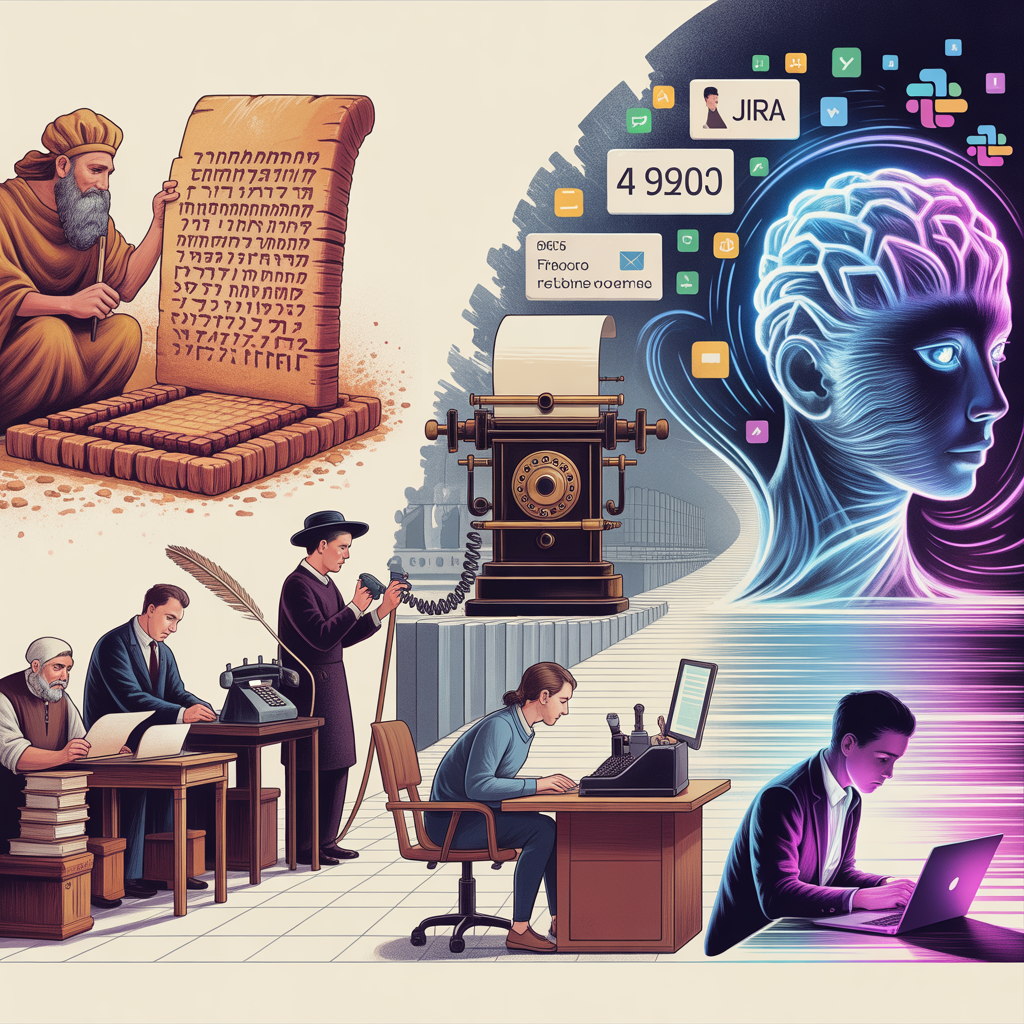
The Weight of Words Through History
Clay Tablets (3400 BCE):
Every word mattered. Clay was labour intensive to prepare, writing was slow, and once baked, the tablet was permanent. Scribes didn't waste space on trivial matters. The medium enforced discipline. If you were going to etch something into clay, it better be important: a contract, an inventory record, a legal decree.
Papyrus and Parchment (3000 BCE - 1450s):
Still expensive, still deliberate, but slightly easier. Writing became more common, but remained the domain of educated elites. The cost of materials meant correspondence was purposeful. You didn't send a letter unless you had something meaningful to say.
Printing Press (1450s):
Gutenberg changed everything. Suddenly, ideas could spread without being hand-copied by monks. But publishing still required investment. Editors existed not just to refine prose but to decide what was worth the expense of typesetting and printing. There was a gate, and gatekeepers.
Telegraph (1840s):
Communication became instant but expensive per word. This created an entire linguistic style “telegraphic speech” where every word cost money, so you stripped messages to their essence. "ARRIVING BOSTON TUESDAY STOP NEED PICKUP STOP."
Telephone (1870s):
Real-time conversation, but still constrained by the cost of long distance and the physical limitation of needing to be at a phone. Calls were scheduled. You thought about what you needed to say before you dialed.
Email (1970s-1990s):
The first major collapse in communication friction. Suddenly, sending a message cost nothing. No paper, no postage, no per-word charges. You could copy ten people as easily as one. The floodgates opened.
Slack, Teams, Jira (2000s-present):
Constant, ambient, zero-friction communication. Creating a ticket takes seconds. @-mentioning someone is effortless. Every thought, every request, every "what if" can be instantly captured and distributed. The cost of communication has effectively hit zero.
The PM at the Center of the Flood
As product managers, we sit at the intersection of all these communication channels. And here's the thing: when communication becomes frictionless, it doesn't just increase in volume, it fundamentally changes in character.
In the clay tablet era, if you wanted something built, you better have thought it through. The act of articulating a request was itself a filter. By the time it reached the builder, it had been refined by the constraint of the medium.
Today? I can't count how many times I've seen:
Duplicate bug tickets filed by three different people in three different ways because it's easier to create a new ticket than search for an existing one
Product requests that span multiple meetings where the same half-baked idea gets discussed repeatedly because there's no cost to bringing it up again
Unused features debated endlessly with clear data showing 0.3% adoption, but "some client at some point might need it" so it stays in the backlog
Priority whiplash where we confidently decide to tackle something next quarter, then move on to something else, always with the assumption we'll "come back to it"
The backlog has become a graveyard of good intentions. We've optimized for ease of input without optimizing for signal-to-noise ratio.
The AI Paradox
Now we're entering the AI era, and I'm watching with fascination and dread. Because AI has the potential to either save us from this mess or make it exponentially worse.
The bad pattern I'm already seeing: Someone gets a client request, opens ChatGPT, and prompts: "Write me a product spec for [feature]." They copy-paste the output into Jira without reading it critically, without questioning if it's even the right solution, without engaging their brain. We've gone from "too easy to communicate" to "too easy to generate communication." The noise just multiplied.
But there's a better way. AI could actually help us rediscover the discipline of the clay tablet era, not through artificial scarcity, but through intelligent filtering.
Building Better Filters
Here's what I'm experimenting with and what I think the future of PM communication looks like:
AI as a brainstorming partner before creating requests
Before writing up a feature request, I'll spend 15 minutes with an AI discussing: Is this really the problem? What are we actually trying to solve? What alternatives exist? Have we tried anything like this before? This forces me to think critically before adding to the backlog. The AI helps me find my blind spots.
AI as an automatic triage system
Imagine AI that scans incoming tickets and flags: "This is a duplicate of PROJ-1247" or "This request has been discussed and deprioritized three times in the past year—here's why" or "The feature this relates to has 0.2% MAU—is this really a priority?" Not to make decisions, but to surface context that would otherwise require hours of manual archaeology.
AI as a pattern detector
What if AI could identify that five different stakeholders have requested variations of the same underlying capability, then synthesize them into one coherent theme? Or recognize that we keep pushing a particular category of work because we're actually missing a prerequisite piece of infrastructure?
AI as a backlog health monitor
A system that identifies tickets that haven't been touched in six months and asks: "Is this still relevant? If not, should we close it?" Or notices that 40% of your backlog relates to a product area you sunset nine months ago. Automated hygiene.
The key in all of this: human in the loop. AI doesn't make the call—it surfaces information that helps humans make better calls faster.
Relearning the Discipline
The clay tablet scribe didn't have AI. They had clay, expensive, labour-intensive clay, and that constraint created discipline. We can't go back to that world, and we wouldn't want to. But we can build new systems that help us rediscover the value of that discipline.
As PMs, our job isn't just to manage backlogs, it's to manage signal in an ocean of noise. The technology that made communication easier has made our jobs harder. The next wave of technology should help us reclaim our focus.
Before you create that next Jira ticket, ask yourself: If this required chiselling into clay, would I still write it? If the answer is no, maybe it doesn't need to exist.
And if the answer is yes? Then write it well, write it clearly, and make it count.
