
When Will the Agile Manifesto Get an AI Upgrade?
Just a few years ago, my feed was a constant stream of Agile frameworks, Scrum certifications, and "the right way" to do stand-ups. We all know the history (if not, a quick ChatGPT prompt will get you up to speed), but one simple document always stands out: the Agile Manifesto.
Think of it as the 12 commandments of software development. We’ve looked up to them for over two decades. But as I sat down to re-read them recently, I couldn’t help but wonder: In a world where AI is writing “half” our code and predicting our sprint velocity, is this 2001 document still our "North Star," or is it time for a 2026 version?
What principle is most prone to AI update?
So manifest is written for sure with human in the middle of everything, but today we have AI agents, Agentic AI, RAG, ChatGPT… I don’t think all of them should be updated.
Satisfying the customer through early and continuous delivery.
AI is moving us from "early" to "instant." We are no longer just delivering software; we are delivering learning loops. With AI-integrated CI/CD, "continuous" is now measured in minutes. The risk? We might ship fast but ship wrong. The update should emphasize continuous value over just continuous code.
Business people and developers must work together
That duo has become a Triad. Right? We now have AI Agents—LLMs that aren't just tools, but active participants. They write the first draft of the specs, they generate the boilerplate, and they flag logic flaws in real-time.
Agile processes promote sustainable development... to maintain a constant pace indefinitely
The problem? AI doesn't get tired. It can produce code 24/7. For a human, this can feel like being chased by a high-speed train. To keep up without burning out, we need to redefine it. Sustainable development now means using AI to handle the "drudge work" (documentation, unit tests, refactoring) so humans can focus on deep work.
Continuous attention to technical excellence and design.
This used to be a manual human burden. Now, AI performs real-time code auditing and architectural suggestions. However, there’s a new trap: "Vibe Coding." This is when developers jump into implementation before thinking through the architecture because the AI makes it so easy to generate code. We need a principle that protects intentional design in the age of effortless generation.
At regular intervals, the team reflects on how to become more effective, then tunes and adjusts its behavior accordingly
In the past, retros were often based on "vibes"—how we felt the sprint went. Today, we involve AI in the mirror: Instead of guessing why a sprint failed, we use AI to analyze the "Cycle Time" and "Change Failure Rate." AI can look at Slack channels or PR comments to say, "Hey, the team's tone was 30% more stressed this week—maybe the technical debt in Module X is hitting a breaking point."
Are there new Agile frameworks/methodologies based on AI?
Quick Google search says that there are quite a few. According to the several articles, I’ve explored in details, we are witnessing a transformation where AI is no longer a tool used by the team, but a central collaborator. This has led to the emergence of frameworks that are replacing traditional Agile practices.
The AI-Driven Development Life Cycle (AI-DLC)
From Sprints to "Bolts" Think of AI-DLC as Agile on steroids. In this framework, traditional two-week sprints are replaced by "Bolts"—intense, high-velocity work cycles that last only hours or days. AI takes the lead by rapidly generating requirements, code, and tests, while humans act as "curators of intent," ensuring the machine stays aligned with the business goal. It turns developers into strategic directors rather than manual builders, though it requires constant human validation to ensure the AI doesn't hallucinate a feature you didn't ask for.Vibe Coding: The Purest (and Riskiest) Form of Agile
Popularized by Andrej Karpathy, Vibe Coding represents the radical extreme of the Agile value: "Working software over comprehensive documentation." In this methodology, the "programming language" is simply English. The developer describes a project to an AI, checks the result, and iterates based on the "vibe" of the output. While it’s the ultimate version of rapid prototyping and empowers non-coders, it can be a nightmare for professionals. It often ignores architecture, leading to "development hell" where the code works but is impossible to maintain or secure long-term.
Deep Dive: Karpathy Vibe Coding Full Tutorial
The Agile AI Canvas
The Agile AI Canvas is a strategic tool designed to help teams integrate AI without breaking the core of Agile. Instead of just "coding and hoping," this framework adds a layer of visibility to the sprint. It forces teams to define AI behaviour, trust criteria, and ethical considerations right alongside their user stories. It’s perfect for Product Owners who need to move from "writing tickets" to "defining intent," ensuring that every AI-generated feature has a human-verified "Why.".Deep Dive: The AX Sprint Canvas & AI Framework
Scrum+AI: The Hybrid Framework
As featured in the European Scrum AI Agile Guide 2025, this is a direct evolution of the traditional Scrum framework. It officially recognizes AI Agents as actors within the team. In this model, ceremonies are transformed:. AI analyses team history to provide a "predictive" baseline for velocity (often hitting 85% accuracy), allowing humans to adjust for the "unknowns." AI summarises blockers from the previous day’s code commits so the team can focus on solving problems rather than just reporting status.It demands high-quality data and a shift in leadership—you have to trust the data even when it contradicts your "gut feeling."
Deep Dive: European Scrum: AI Agile Guide 2025 (PDF)
There are more, but the above ones I’ve deemed most interesting to look at.
How I Would Update Agile Manifesto? (Final Thoughts)
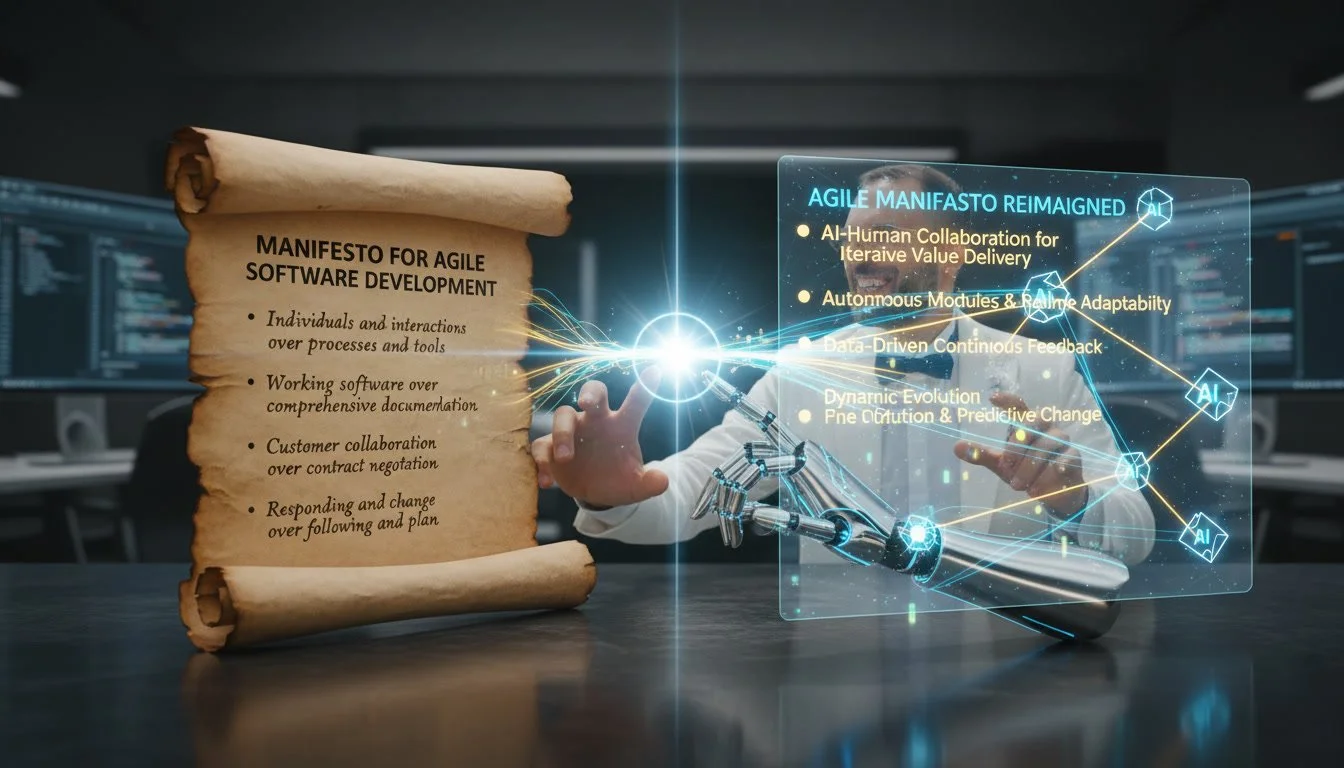
If I were to sit in that room in Utah today, the whiteboard wouldn't just be about "individuals and interactions." It would be about Intent and Orchestration. If we want Agile to survive the AI era, we need to evolve the four core values. Here is my proposal for the AI-Augmented Agile Manifesto:
Intent and Prompting over Processes and Tools.
Working Systems (and their 'Why') over Generated Code.
Agentic Collaboration over Rigid Silos.
Proactive Evolution over Reactive Adjustments.
The original manifesto was a rebellion against "The Machine"—the slow, bureaucratic corporate machine. Today, we are working with an actual machine. Is it time for another rebellion?
The goal of Agile has always been to shorten the distance between an idea and a satisfied customer. AI has shortened that distance to nearly zero. But speed without direction is just a fast way to get lost. As Product Managers, our role is shifting from managing the "How" (schedules, tickets, and updates) to mastering the "What" and the "Why."
The Manifesto isn't dead; it’s just finally getting the high-speed engine it was always meant to have.
