
You Asked to Join. You Didn't Participate. Make It Make Sense.
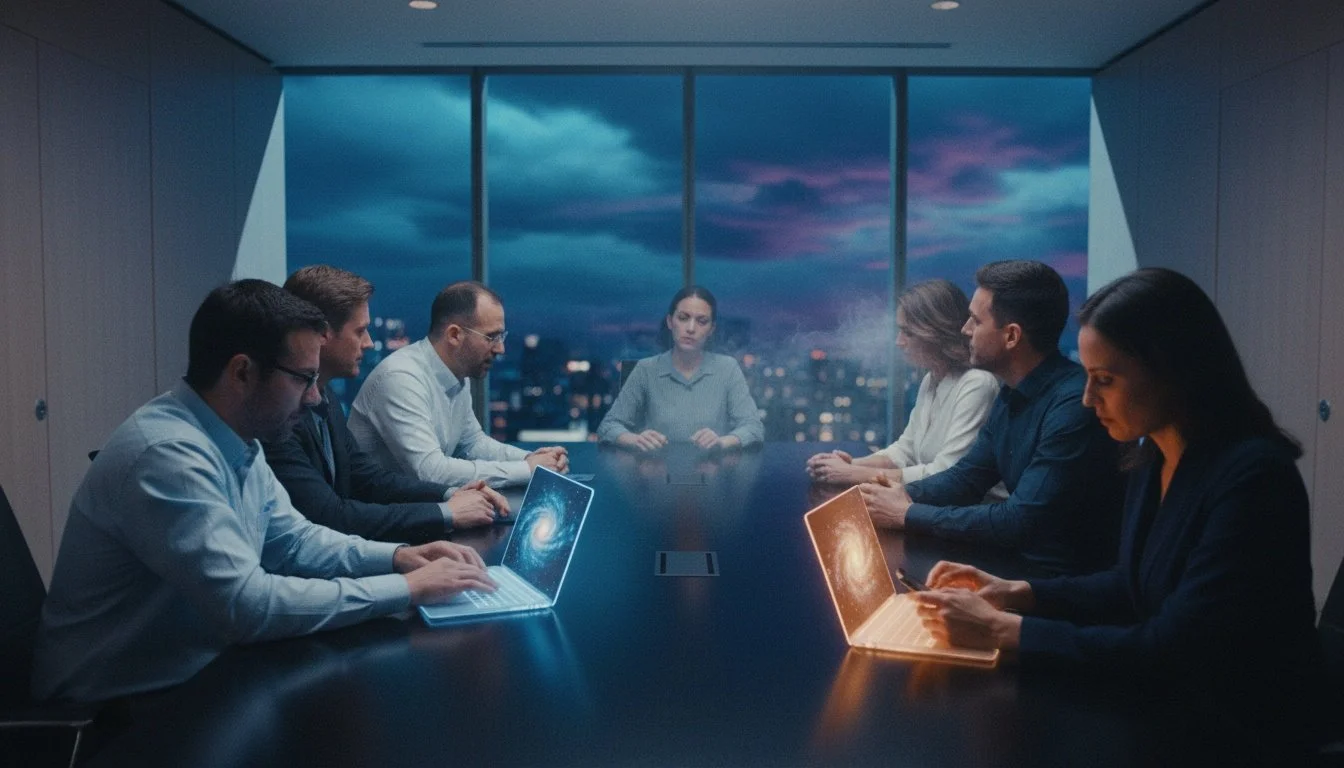
There's a pattern I keep noticing. I send out a meeting invite. I ask who needs to be there. Hands go up. People ask to be added. And then, the call starts, and at least a third of the room is clearly somewhere else. Typing. Scrolling. Living their best parallel lives. The camera is on, the microphone is muted, and the eyes are zoomed out.
These are the same people who, three days earlier, asked me to include them.
And these are also, often, the same people who will complain, in a retro, in a Slack message, over coffee, that they have too many meetings.
I'm not writing this to shame anyone. I'm writing this because as a product manager, I spend a lot of time thinking about signals versus noise, about why people behave the way they do in systems, and about what it costs when those systems go unchallenged. Meeting culture is one of those systems. And it's quietly expensive in ways most organisations don't bother to calculate.
Being included in the meeting is a good feeling
There's a reason people ask to join meetings they don't intend to fully attend, and it's not laziness. It's something more human than that.
Being on the invite list is a form of recognition. It signals: you matter here. Your role is relevant. You're in the loop. Getting excluded from a meeting, even one you would have happily skipped, can feel like a small demotion. An invisible drawing of a boundary you didn't consent to.
There's a term for this in behavioural psychology: FOMO, but the professional version is more subtle. It's not the fear of missing a party. It's the fear of missing context, decisions, credit. The fear of being the person who wasn't in the room when something important was said, and therefore can't claim ownership or authority over the outcome.
This is compounded by organisational culture. In many companies, visibility is a currency. If you're not seen, in meetings, on Slack, on status updates, you can start to feel like you're disappearing. And meetings, for all their dysfunction, are one of the most reliable ways to be seen. You don't even have to say anything. You just have to be there.
So people ask to join. Not because they want to work. Because they want to belong.
How come then you join if you don't want to be there?
This is where it gets genuinely interesting to me, because it's not irrational behaviour. It's entirely rational behaviour inside a broken incentive structure.
The ask to be included happens at the moment of anticipation. The meeting is a week away. The topic sounds relevant. You imagine yourself contributing, being sharp, asking the right question. So you request an invite.
Then the day arrives. You have three deadlines. A Slack thread demanding your attention. An inbox that grew overnight. The meeting starts, and the cost-benefit has completely shifted, but you can't leave, because leaving would be noticed. So you stay, and you multitask, and you tell yourself you're "listening in case something important comes up."
Research consistently backs this up.. A 2025 study found that nearly two-thirds of employees admitted to joining meetings solely to appear engaged, while another 63% said they did so out of social or political expectations. It's not apathy. It's performance of participation, driven by the fear that not being there is worse than being there and doing nothing.
And multitasking is contagious, which makes this worse. Research by Professor Steven Rogelberg at UNC Charlotte found that when some attendees start multitasking in a meeting, it spreads. People feel guilty if they're not multitasking, like they're being inefficient by just... listening. So the whole room quietly descends into a collective pretence of a meeting.
I've sat in those meetings. I've probably run a few.
How much it costs companies for meaningless meetings and joining the call?
Let me make this concrete, because it usually isn't.
Companies talk about meeting culture in abstract terms, "we need fewer meetings," "let's be intentional", but rarely sit down and do the maths. Here's some of it.
According to aggregated 2025 data, meetings cost the US economy an estimated $532 billion per year. Employees spend an average of 35 hours a month in meetings, and only 45% feel those meetings are productive. That means roughly half of all meeting time, statistically, is waste.
The more granular figure comes from research by Rogelberg for Otter.ai: for a company of 5,000 people, unnecessary meetings cost approximately $100 million annually. Scaled down, a 100-person company is still looking at around $2.5 million a year in lost salary value from meetings that didn't need to happen.
The State of Meetings Report 2025 put the daily US figure at roughly $25 million lost per day to poorly planned or unnecessary meetings. Per employee, the average annual waste lands around $6,280 in salary, just from sitting in meetings that generated nothing.
And that's only the direct cost. It doesn't count the deep work that didn't happen. The feature that got pushed. The decision that got delayed because the person who needed to make it was on their fourth call of the morning. Nearly 68% of employees say frequent meetings mean they don't have enough uninterrupted time to do focused work during the day.
The invite-list inflation I described earlier, people asking to be added "just to be in the loop", is a direct contributor to all of this. Every unnecessary attendee is a multiplier on the cost. A one-hour meeting with ten people present, three of whom are doing email, is not a one-hour cost. It's a ten-hour cost, with three hours actively generating confusion rather than value.
Final thoughts
Here's where I land and why this isn't just a meeting-hygiene post.
Each of the dynamics I described above is something I think about as a product manager. The psychology of wanting to be included: that's about team culture, recognition, and whether people feel safe enough to opt out without it meaning something. The gap between anticipation and execution: that's about how we set expectations and communicate the real cost of attention. The financial waste: that's about organisational discipline and whether leadership actually treats people's time as a resource worth protecting.
For me, the job is always about eliminating noise to get to signal. In product, that means cutting features that don't serve the user. In roadmap conversations, it means saying no to things that sound good but don't move the needle. And in meetings, it means being the person who asks: does this person actually need to be here? Do I?
Culture change on this is hard because it requires people to opt out of something that feels socially safe. Declining a meeting invite takes more social courage than accepting one. And that's backwards.
I've written before about the dysfunction of daily standups, how a well-intentioned ritual becomes a performance once nobody is honest inside it. This is the same problem, broader. When presence becomes a proxy for contribution, and attendance becomes a proxy for engagement, you've lost the thread of what the meeting was actually for.
My take: the best meeting culture I've seen is the one where people feel genuinely comfortable saying, "I don't need to be here, send me the notes." Not because they don't care, but because they trust that their absence won't be misread. That's not a process fix. That's a trust problem. And trust is, as always, the product manager's actual job.
