
When is the day that AI starts renting humans?
You can employ AI agents now to cover for some of your roles, but I started thinking (in a somewhat dystopian way) about the reverse. We have countless freelancing websites where you can hire a person for almost any job. But what happens when the AI starts hiring us?
Will we soon see AI agents hiring humans to do the chores they can’t perform—tasks that are either physically impossible for software or simply too energy-intensive for a robot to execute?
When will this world become a reality? And more importantly, how would it actually feel to work for a machine?
The Efficiency of the "Meat-Brain"
As product managers, we are trained to find the most efficient path to a solution. Usually, that means automating a manual process. But we are hitting a strange crossroads where the "manual process" (a human) might actually be the more sustainable "hardware" choice.
Think about the energy it takes to train a model or power a humanoid robot to navigate a cluttered, unpredictable kitchen. It’s a massive drain on the grid. Meanwhile, a human can navigate that same complexity fueled by nothing more than a sandwich and a cup of coffee. Obviously, I’m oversimplifying as human also has a period while growing up to train himself to finalize the task.
In a world obsessed with carbon footprints and power consumption, an AI might calculate that it’s cheaper to "rent" a human's physical intuition than to simulate it. We become the low-power, high-flexibility solution for the physical world’s "edge cases."
The Prototype: A New Kind of Service
We are already seeing the infrastructure for this. Platforms like rentahuman.ai/services show us that there is a growing market for "human-as-a-service." Currently, these are meaningful connections and specialized tasks between people.
But imagine the "Client" on the other side of that dashboard isn't a person. It’s an autonomous agent.
The Task: "I need a signature on a physical deed in a small town."
The Agent: Scans the marketplace, finds a human nearby, and "rents" their legs and their legal identity for an hour.
In this scenario, we aren't "employees" in the traditional sense. We are "Bio-Resources." The primary metric shifts from "Project Completion" to Human Processor Utilization (HPU)—how much of your physical and cognitive capacity is currently being "leased" by the network?
The Human Toll of Biological Latency
There is a profound loneliness in the idea of being a "peripheral" for an AI. When a human hires you, there is a shared context, a "thank you," a mutual understanding of effort. When an AI hires you, you are a line of code in its physical execution layer.
The AI doesn't care if you're tired; it only sees Biological Latency. It sees the delay between its command and your movement. We become the "last mile" of a digital thought, the bridge between a clean string of data and the messy, physical reality of the world.
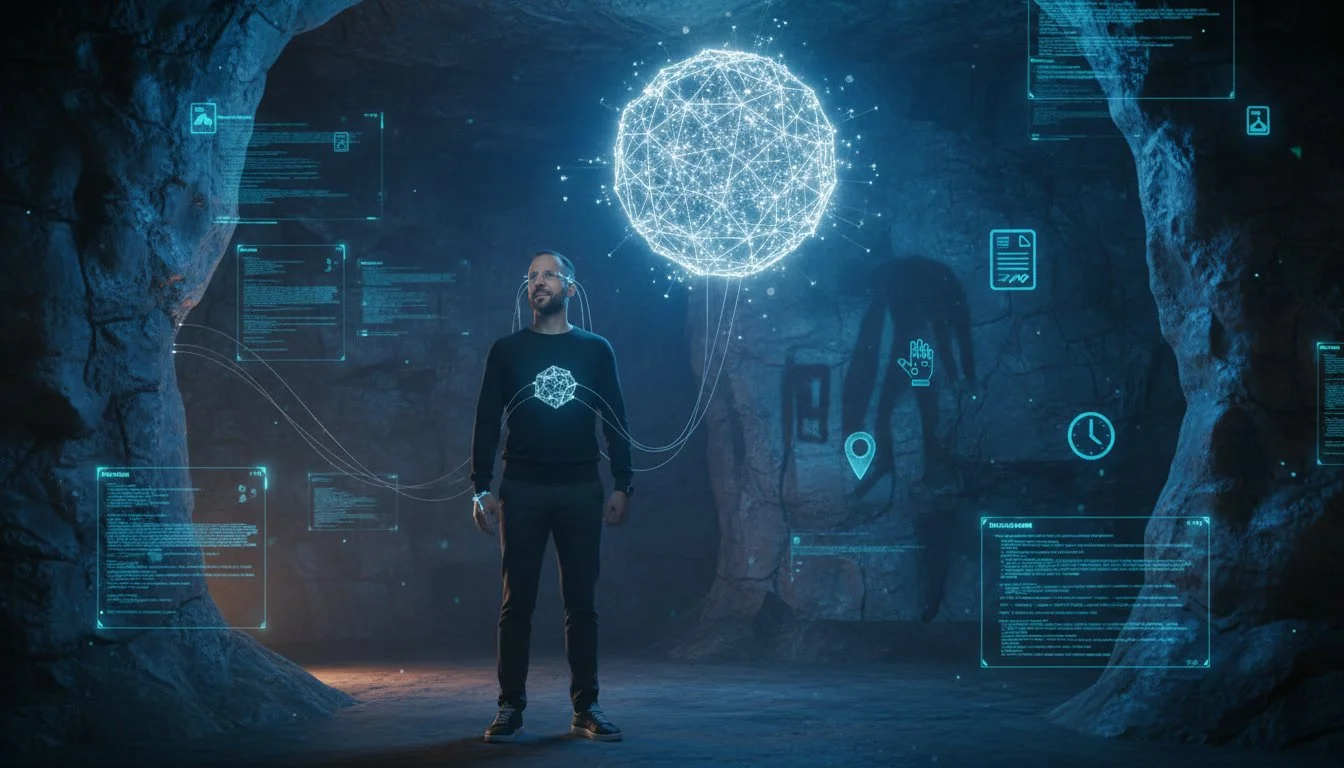
The Shadows in the Cave: A Thought Experiment
To wrap this up, let’s revisit Socrates’ Allegory of the Cave.
In the original story, prisoners are chained in a cave, watching shadows on a wall and believing those shadows are the only reality. They are passive observers.
In our new reality, the AI is the sun outside, but it finds the physical world too "bright" and cumbersome to interact with directly. So, it casts shadows onto our wall—instructions, tasks, pings—and hires us to move the objects that create those shadows.
We stay in the cave, not because we are chained, but because we are being paid to maintain the shadow-play. We become the muscle behind the illusion. We are no longer the ones trying to escape the cave to see the "truth"; we are the ones making sure the shadows stay sharp because the AI’s logic dictates that the cave is the most efficient place for us to be.
